

It’s Flash Fiction Friday! Welcome back after a long and dark offseason. I am very happy to bring the beloved weekly writing prompts back to help you write and, maybe, get into a habit of writing.
6 February prompts from Scoot
Write about the weather
a sharp bluntness
“who do you think will notice?”
A character who isn’t from here
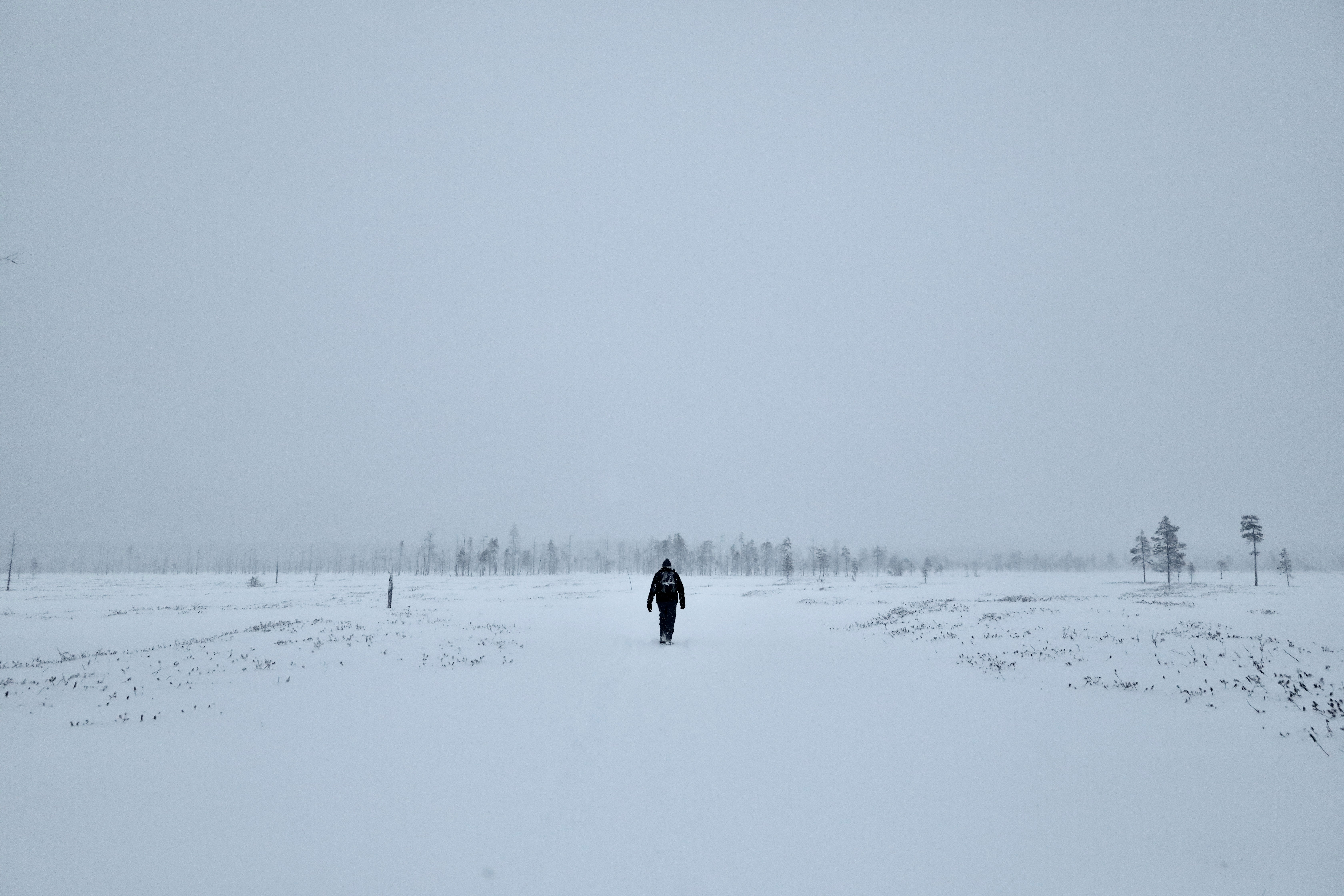
Al shivered. With temperatures hovering near zero on the Fahrenheit scale, he knew it would only be a matter of time until hypothermia set in. His fingers were already a frightening shade of blue, and he assumed his toes were the same. He needed to get out of the weather and into some kind of shelter soon or his mission would fail and the resources spent on it would have been wasted.
“Who do you think will notice if I freeze to death here?” he thought. And then automatically corrected himself: “Whom.” Or was it who after all? “WHOMever created this language did not make it easy to get things correct.”
Al shifted his suit as he followed the map toward the building assigned to him by the project managers. He grumbled with his characteristic sharp bluntness about the haphazard organization and lack of research for this environment. He had done his own research, which was the reason he had insisted on a second skin thermal suit. He wished he had thought about hands and feet, but at least the unfamiliar internal organs were protected.
In the distance he finally spotted the brown roof of the building in the specs he carried with the map. Calculating the distance, he figured he would be there in minutes if he used his full speed. Given the weather and the remote location, he decided it was worth the risk of being seen by one of the natives. Within two minutes, he had traveled the mile and had unlocked the door and entered.
The building appeared to be an old barn on the exterior, but inside the space held a myriad of specialty devices for measuring time and space on this odd blue planet. Al’s job was to learn how they intersected so that his people could make themselves available for intergalactic commerce. Procyon, the star around which Al’s planet, Cyon, orbited, had recently emitted radiation that triggered photodissociation in Cyon’s upper atmosphere, producing byproducts made up largely of oxygen—useless to Cyonites. Earth was rumored to have large stores of depleted uranium that Cyonites wanted for harnessing procyonid energy. The Cyonite Major Prelate hoped that opening a commerce stream would be mutually beneficial—if Al could learn how to enter the Earth’s space-time continuum.
The first thing Al wanted to do was thaw out. He reset the temperature in the thermal suit to a comfortable (for his species) 350 degrees Kelvin and plugged it in to continually recharge. He removed the boots that covered his humanoid feet and noted that they were also as blue-white as his fingers. That was troubling. He needed to discover a better way to protect this form from the cold. Somewhere in this building was a book.
Al clicked on the light and let out a squeak of discomfort. The room radiated with what seemed like a thousand points of light across an unfamiliar color spectrum and the machinery lost all definition to him. As quickly as he could feel the switch again, Al shut off the light. His head hurt now and he still hadn’t figured out a way to warm his hands and feet. He analyzed his situation.
“I can see enough to work on space and time, but not well enough to absorb information from an Earth-based source. Engineers. Meh. They think of the big complex things, but neglect to account for little things like light. So, what are the options here?”
Al looked around at his devices. They hummed efficiently, emitting a silvery glow, which gave Al an idea. He remembered insisting on backup screens when the first team visited Earth to install the devices. He moved carefully to the storage area, wincing a bit as his feet and hands began to burn. He thought he remembered that as a good sign, but he wasn’t sure. Sure enough, the containers of backup screens were neatly stacked.
“I think,” he muttered, “three might provide adequate illumination with minimal negative effect as long as I can maintain the spectrum. Should have thought about Earth light before. Engineers are impractical theorists, but I should have thought of it.”
Al grouped the screens together. Since they were designed for backlighting any of the devices, their silver glow was unimpeded by dials, knobs, or information. Grouping them provided a steady light sufficient for reading, but not uncomfortable for Cyonite eyes. Al was pleased with himself, although his satisfaction was marred by the throbbing in his toes and fingertips.
Looking around the quietly illuminated room, Al finally saw the promised shelves of books. They were intended to give him a sense of human culture so he could determine the best way for the Major Prelate’s cabinet to begin talks with Earth leaders about sharing resources. Al was not a diplomat by any stretch of any imagination. He was a practical worker, an inventor, a field master whose main task was to learn Earth’s space-time continuum and whose secondary task was to remain unseen. The humanoid form was hard enough to imitate and maintain; trying to master the details like facial features was above his pay grade.
When Al had studied human language in school, he assumed that it was all oral. Then he learned about books with hard covers over soft paper signatures. The books on these shelves were entirely limp and soft with titles like Good Housekeeping, Vogue, AARP, People, and National Geographic.
“Useless,” he grumbled. He kept looking.
On the bottom shelf he found titles that were more promising: Popular Mechanics, Scientific American, and six editions of The Farmer’s Almanac. Finally he found what he needed: Bushcraft and Survival Skills. Taking it nearer the luminous screens, Al made himself as comfortable as he could, and began to read.
He didn’t get far before realizing he was looking at the problem of his hands and feet all wrong. The human explanations of wrapping the extremities in warm layers wouldn’t work without an actual circulatory system. What he needed was an internal heat redistribution. He shook his head as the obvious solution formed in his mind.
“The cold must have affected my mind along with fingers and toes,” he groused. With that, Al removed the torso portion of his thermal skin suit and draped it over his head. He allowed his hands and feet to return to a more pseudopodiastic form, allowing his own internal radiation flow easily to those extremities. He felt the burning ache as his cells began to heal. He realized it would take some time before he was fully functional again, so he relaxed his entire humanoid form and fell asleep.
Work would wait.


Okay, to be honest, there's times I wouldn't mind being able to shift into a pseudopodiastic form and just lie around like that. Sounds comfy!