
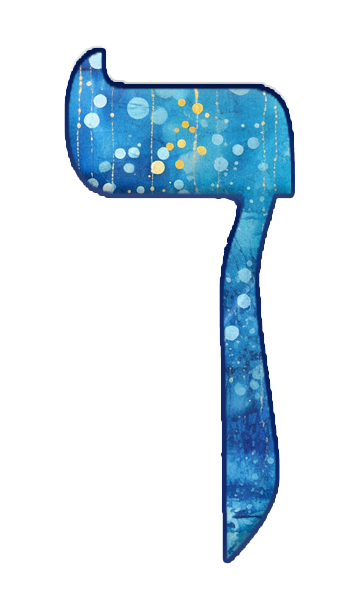
Psalm 119:25-32 ד (Dalet)
A Journey through Psalm 119

Psalm 119:25-32 ד (Dalet)
My soul clings to the dust;
give me life according to your word!
When I told of my ways, you answered me;
teach me your statutes!
Make me understand the way of your precepts,
and I will meditate on your wondrous works.
My soul melts away for sorrow;
strengthen me according to your word!
Put false ways far from me
and graciously teach me your law!
I have chosen the way of faithfulness;
I set your rules before me.
I cling to your testimonies, O Lord;
let me not be put to shame!
I will run in the way of your commandments
when you enlarge my heart!
(ESV)
We all suffer to some degree. Sometimes the suffering comes from outside circumstances beyond our control, but other times, we bring our despair on ourselves. Even when we desire to live a holy life, we inevitably succumb to the natural human tendency to selfishness and self-sufficiency. The apostle Paul wrote:
So I find it to be a law that when I want to do right, evil lies close at hand. For I delight in the law of God, in my inner being, but I see in my members another law waging war against the law of my mind and making me captive to the law of sin that dwells in my members. Wretched man that I am! Who will deliver me from this body of death? (Romans 7:21-24, ESV).
The psalmist in this section seems to feel the same way Paul did. He begs the Lord to “put false ways far from me and graciously teach me your law“ (v 29). For both the psalmist and Paul, the recognition of human depravity within the heart and mind must lead to repentance so that the Word can begin to transform us. Spurgeon noted that ד (Dalet) roughly corresponds to the English “D,” and that this pericope can be studied with a series of alliterative words: Depression, Devotion, Determination, and Dependence. I add Death, because it is only by death to self that we become truly dependent on the Father.
Depression
Having dealt with anxiety and depression myself, I recognize the feeling of “down in the dust” from verse 25. Those are the helpless and hopeless moments that make all effort seem pointless. Clearly David, whom Spurgeon believed to have written this psalm, suffered seasons of tremendous depression. Some of his trials came from outside—being hated by both his father-in-law and his son are examples. Other times, his depression came from the futility of trying to manage his own heart. Like Paul, he wanted to live in a way that reflected God’s heart, but his mind and body clung to the certainty of the earthly when the heavenly seemed too far away.
While our salvation is completed at the crucifixion and resurrection once and for all, our sanctification is a life-long battle between the flesh and the spirit. Recognizing the sin of our stubborn attempts to make ourselves holy is the first step toward obedience in all things. We must lament our connection to the things of this world if they interfere with the transformation God is working in us. Spurgeon noted that acknowledging this tension is an important sign that we do seek after God, saying,
Many are of the earth earthy, and never lament it; only the heaven-born and heaven-soaring spirit pines at the thought of begin fastened to this world (3883).
When our souls melt away for sorrow, we are ready to be taught the life-giving precepts of the Word and become devoted to learning them well.
Devotion
Devotion to God comes through meditating not only on His Word, but also on His works. His words give life, reviving us from despair, and His works illustrate the steadfast love of Him who keeps promises. Psalm 8, one marked as having been composed by David, reflects on how the natural world inspires our devotion to God.
When I look at your heavens, the work of your fingers,
the moon and the stars, which you have set in place,
what is man that you are mindful of him,
and the son of man that you care for him?
(Psalm 8:3-4 ESV).
David ended that psalm by praising the majestic name of God over all the earth. The beauty and wonder of nature brought him back to the glory of God and the awe of God’s goodness toward him. We are so small, yet God’s love for us shines brighter than the stars we see.
Determination
The psalmist goes on to say, “I have chosen the way of faithfulness” (v 30). In spite of depression, in spite of despair, and in spite of dread on this side of life, the psalmist is determined to press on to the higher calling of God. He sets the rules ahead of him, clings to the testimonies of the Lord, and runs toward the commandments, much like Paul who wrote, “For those who live according to the flesh set their minds on the things of the flesh, but those who live according to the Spirit set their minds on the things of the Spirit“ (Romans 8:5). Determination to live faithfully requires understanding that we cannot do so in our own strength. Spurgeon argued,
The word of God shows us that he who first made us must keep us alive, and it tells us of the Spirit of God who through the ordinances pours fresh life into our souls; we beg the Lord to act towards us in this his own regular method of grace…Being truly sorry for his fault, and having obtained full forgiveness, he is anxious to avoid offending again…Justified men always long to be sanctified. (3884).
Choosing Jesus also means choosing to live fully and joyfully, not because we feel like it, but because His grace will bring us to Himself, no matter the failures of our fumbling faith. He knows us because He made us, and He loves us all the way to eternity. Sanctification takes a lifetime of choosing Jesus.
Death to Self
Being sanctified begins with confession and lament, leading to a death to self in pursuit of life in Christ. Spurgeon noted that “Open confession is good for the soul” (3884) and “Our confessions are not meant to make God know our sins, but to make us know them” (3884). It is in the process of dying to self that the psalmist opened this section and then continued midway through when he wrote, “My soul melts away for sorrow; strengthen me according to your word” (v 28). Spurgeon said “Heaviness of heart is a killing thing,” adding, “There is one good point in this downcast state, for it is better to be melted with grief than to be hardened by impenitence” (3886). Paul, in his letter to the Galatians, made clear that death to self leads to life in Christ:
For through the law I died to the law, so that I might live to God. I have been crucified with Christ. It is no longer I who live, but Christ who lives in me. And the life I now live in the flesh I live by faith in the Son of God, who loved me and gave himself for me. (Galatians 2:19-20 ESV).
When we ponder the steadfast love and goodness of God, we see the futility of living under the law, even as we commit to learning it. Someone once said that we do not drift into holiness. Dependence on grace and mercy in all things is a lifelong pursuit. We are not passive partners in our sanctification. We run after godliness in the power of God’s grace.
Dependence
We live in that grace day by day, and when we do, our hearts are free to run harder and faster the race before us. Sin will continue to entangle us as long as we live, but when we fix our eyes on Jesus, we will find ourselves entering a kingdom that cannot be shaken. We will be forever freed from depression, temptation, and the shadows of this world that draw us away from the Lord. We grow in holiness by our daily attention to the laws and statutes of God because they free us to love that which is divine and eternal. When we depend on Him, He changes our hearts so that, no matter the external circumstances, we can live joyfully. As Spurgeon ended his discussion of this section,
We must run; for grace is not an overwhelming force which compels unwilling minds to move contrary to their will; our running is the spontaneous leaping forward of a mind which has been set free by the hand of God, and delights to show its freedom by its bounding speed (3889).
My thoughts from May 2020:
COVID19 quarantine orders are beginning to lift in many places, and people are stepping outside to regain some kind of control over their lives. With relaxed shelter-in-place advice, people are beginning the process of making meaning of the last two months. Arguments over blame for the pandemic and conspiracy theories are replacing the “we’re all in this together” mindset of March and early April. The virus is shifting from a medical issue to a political one; statistics are cherry-picked, ad hominem attacks are retaking center stage, and facts are so surrounded by opinions that it is hard to know what’s true.
After 9/11, the last major national crisis, people came together in community to support each other, whether or not they were personally touched by the people lost to terrorist hijackers. This time, although the death toll is far higher, that immediate sense of community is already fading. It makes me wonder, why can’t we move forward as a culture to at least try a season of grace?
Psalm 119 offers one reason: when we lose our focus on the Father and His ways, we end up in the dust. We can’t see clearly through the dirty lenses of our own thoughts, and so we respond by lashing out, trying to feel our way to some hopeful stronghold.
The example of the psalmist is another way to find our way that relies on God’s strength instead of our weakness. We choose to meditate on God’s wonder, we confess our misguided ways to our Father, we choose faithfulness, setting His rules before us and clinging to His testimonies. When we choose these better attitudes, God will teach us His ways (far higher than ours), keep us from shame, and enlarge our hearts. Our larger hearts allow us to act out of compassion instead of fear. We don’t need to be right in the eyes of social media and the world when we live according to His word.
A NOTE:
Psalm 119 is too rich and too vast to leave to my own thoughts. Six years ago I was content to share my personal responses as I navigated the events of the summer of 2020, but since then, I have learned to frame my responses in light of scholarship and thoughtful research.
Psalm 119 is also too rich and too vast to delve deeply into centuries of scholarship for anything less than a multi-volume publication, the scope of which is beyond a simple devotion on Substack. For this project, then, I have decided to limit my external references to a few trusted sources that will be listed in the “References and Resources” at the end of each article. Primarily, I will rely on the wisdom of Charles Haddon Spurgeon’s treatment of Psalm 119 in The Treasury of David: The Complete Seven Volumes, the NRSV Cultural Backgrounds Study Bible, and Blue Letter Bible online for its translations. Bible Gateway has extensive resources and I will include those as I use them.

References and Resources
(links are likely affiliate links for which I may receive a token of compensation)
Blue Letter Bible. Sowing Circle, 1996–2025, www.blueletterbible.org. Accessed 13 Apr. 2026.
Coogan, Michael D., et al., editors. The New Oxford Annotated Bible with the Apocrypha: New Revised Standard Version. 5th ed., Oxford University Press, 2018.
The Holy Bible, English Standard Version. Crossway Bibles, 2001. Bible Gateway, www.biblegateway.com. Accessed 13 Apr. 2026.
The Holy Bible, Holman Christian Standard Bible. Holman Bible Publishers, 2015. (Note: I like this one’s wide margins for annotation.)
*Spurgeon, Charles H. The Treasury of David: The Complete Seven Volumes. Hendrickson Publishers, 2004. Kindle ed. (Note: A hard copy in three volumes is available here.)
Walton, John H., and Craig S. Keener, editors. NRSV Cultural Backgrounds Study Bible. Zondervan, 2019. (Note: the NRSV is out of print, but the NIV is available here, and the NKJV here.)
*I cannot recommend this text highly enough. Each page’s wisdom demands reflection and return to the Scriptures.