
Psalm 119:81-88 כ (Kaf)
A journey through Psalm 119

My soul longs for your salvation; I hope in your word.
My eyes long for your promise;
I ask, “When will you comfort me?”
For I have become like a wineskin in the smoke, yet I have not forgotten your statutes.
How long must your servant endure?
When will you judge those who persecute me?
The insolent have dug pitfalls for me; they do not live according to your law.
All your commandments are sure; they persecute me with falsehood; help me!
They have almost made an end of me on earth,
but I have not forsaken your precepts.
In your steadfast love give me life,
that I may keep the testimonies of your mouth.
(ESV)
Waiting
Hard days come for us all. The hardships may look different, but our emotional response is similar: When will this season be over? How long can I endure? Where is God?
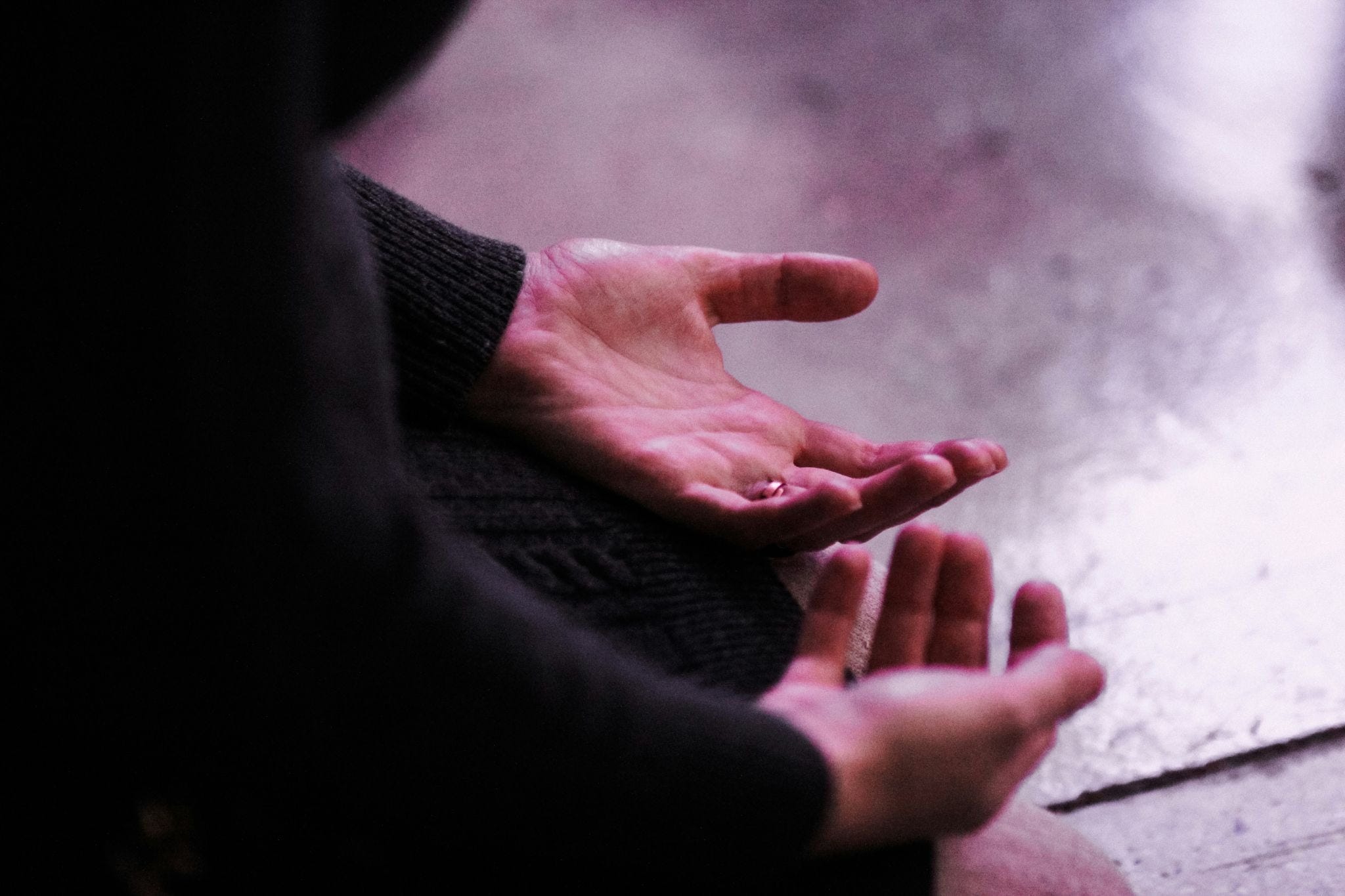
The psalmist asked these same questions, looking to heaven with his hands outstretched, waiting to hear from God. The picture in this section of the psalm is one of a person at the end of himself, weary of the world, yet trusting the promises of the Father’s steadfast love.
Even the Hebrew letter speaks to this posture of utter dependence. The word כ (Kaf) means the palm of the hand, cupped to receive something placed in it. The psalmist in his longing can only raise his empty hands to the Lord, longing for them to be filled with life. His body is limp with weariness, worn down by both the words and actions of his enemies. He knows there is nothing he can do to argue away their malice, and so he looks for God to keep the promise of salvation and peace. He clings to hope, but he is also ready for God to put an end to his suffering.
Our enemies may not be foreign armies, but their weapons against us often pierce us to the heart. Betrayal, gossip, and envy can leave us lonely and isolated. We raise our hands and ask the same questions: When will you comfort me? How long must I endure?
We would prefer short times of trial and long times of peace, but this world does not order itself according to God’s righteousness or goodness. We long for God to set things right quickly, but our faith grows when we ache for God in the middle of hardship. Spurgeon noted that our desire for quick answers to prayers of longing reflects our need for the grace of hope to keep us from utter despair.
With Assurance
Even with his palms turned up in a desperate plea for life, the psalmist holds on to hope. He remembers the statutes and commands of God, following His precepts, even in the midst of the trials. He understands that the Father’s steadfast love never fails. Spurgeon wrote,
The worst circumstances cannot destroy the true believer’s hold upon his God. Grace is a living power which survives that which would suffocate all other forms of existence. Fire cannot consume it, and smoke cannot smother it. A man may be reduced to skin and bone, and all his comfort may be dried out of him, and yet he may hold fast his integrity and glorify his God (p 3936).
Hard times, even impossible times, are common to us all. When those times are brought to us because of our faith, it seems unfair. But we must remember that “we have this treasure in jars of clay, to show that the surpassing power belongs to God and not to us“ (2 Corinthians 4:7). When we are at the end of ourselves, we have the assurance that the Lord’s steadfast love gives us life. We trust that He keeps His promises. The testimonies we speak from our suffering display a hope that cannot be shaken. Or, as Paul wrote,
So we do not lose heart. Though our outer self is wasting away, our inner self is being renewed day by day. For this light momentary affliction is preparing for us an eternal weight of glory beyond all comparison, as we look not to the things that are seen but to the things that are unseen. For the things that are seen are transient, but the things that are unseen are eternal (2 Corinthians 4:16-18).
The steadfast love of the Lord gives us life in the midst of longing. We open our empty hands—not because the waiting is over, but because He is faithful and true. Our testimony is of God’s great goodness, even during the hard days.
Post from 2020:
2020 is looking to be a year where we cry out, “How long?” How long? is a theme that returns again and again throughout scripture. This iteration has two components: physical and political. The components operate separately, but together are wreaking havoc on the US (and the world). “One nation, under God, indivisible” has morphed into multiple cultures without God, increasingly divided.
Believers around the US want to be able to attend church together, they way they did before mid-March. They want to know “how long until things get back to normal?” But there is an element missing in that question. Catastrophes are often catalysts of permanent change for everyone involved. Think about ancient history: a catastrophic meteor took out the dinosaurs, the great flood took the earth’s population to eight, massive wars continually changed national borders, and natural disasters altered physical land masses. According to an article in Science, 536 was the worst year in history to be alive when devastating volcanic eruptions blotted out the sun for 19 months.
Recovering from disaster, both natural and man-made, requires a whole new setting for normal. Major changes in economies, philosophies, and societies mean that the post-disaster realities are not “normal.” New patterns of living, working, and socializing have to be established following any cataclysm that changes land, borders, and population. No one is immune from having to adjust to a “new” normal.
We who are believers should be the first to recognize that changing how we do things in response to the changing world. We have an unshakeable foundation upon which to rebuild, but we must recognize that church life must adapt to spread the gospel to the lost in this new reality. We don’t know what the new reality looks like yet; we are still in the middle of the crisis. But we must prepare our heart and minds for something different, something that crosses the lines of race and social culture into the singular Body of Christ.
So, should we even be longing for church services as they were five months ago? I am beginning to think we need to be thinking forward to a new kind of gathering as believers. Church as social club or sanctified activity needs to end. It needed to end well before the pandemic, which may be one reason God allowed it. I can’t predict what the “new normal” will be, but this psalm reflects a need for us to know the sure commandments of God and focus on His precepts in order to live out His testimonies through the madness that seems to be enveloping our world.
We have an opportunity to unite with believers across culture and ethnicities; COVID19 and the cry out to end racism are both catastrophe and a chance to return to our first love (Greenway, 2014; Revelation 2:1-7). We need to seek a new relationship with the Lord, one wrapped in His Word and one that trusts His steadfast love.
Church services must change so that we who are the Church can fully participate in living a life fully committed to living out the law of the Lord. When we keep His testimonies, we can know that, no matter how the world changes during catastrophes, we are secure in His love for us.
Maybe the Church needs to become geographically smaller in order to have a global influence for the gospel. Maybe each of us as believers needs to take on the mantle of evangelism and discipleship rather than waiting for church staff to do the work while we just attend services. God is calling for believers in the US to seek His face as we navigate what society may look like on the other side of this pandemic, along with every other crazy event of 2020.
We need to BE the Church, not just GO to church. We know His commandments; we now need to embody them for His glory.
A NOTE:
Psalm 119 is too rich and too vast to leave to my own thoughts. Six years ago I was content to share my personal responses as I navigated the events of the summer of 2020, but since then, I have learned to frame my responses in light of scholarship and thoughtful research.
Psalm 119 is also too rich and too vast to delve deeply into centuries of scholarship for anything less than a multi-volume publication, the scope of which is beyond a simple devotion on Substack. For this project, then, I have decided to limit my external references to a few trusted sources that will be listed in the “References and Resources” at the end of each article. Primarily, I will rely on the wisdom of Charles Haddon Spurgeon’s treatment of Psalm 119 in The Treasury of David: The Complete Seven Volumes, the NRSV Cultural Backgrounds Study Bible, and Blue Letter Bible online for its translations. Bible Gateway has extensive resources and I will include those as I use them.
References and Resources
Blue Letter Bible. Sowing Circle, 1996–2025, www.blueletterbible.org. Accessed 13 Apr. 2026.
Coogan, Michael D., et al., editors. The New Oxford Annotated Bible with the Apocrypha: New Revised Standard Version. 5th ed., Oxford University Press, 2018.
Hebrew4Christians. “The Letter Kaf / Khaf.” Hebrew for Christians, www.hebrew4christians.com/Grammar/Unit_One/Aleph-Bet/Kaf/kaf.html. Accessed 22 June 2026.
The Holy Bible, English Standard Version. Crossway Bibles, 2001. Bible Gateway, www.biblegateway.com.
The Holy Bible, Holman Christian Standard Bible. Holman Bible Publishers, 2015.
*Spurgeon, Charles H. The Treasury of David: The Complete Seven Volumes. Hendrickson Publishers, 2004. Kindle ed. (Note: A hard copy in three volumes is available here.)
Walton, John H., and Craig S. Keener, editors. NRSV Cultural Backgrounds Study Bible. Zondervan, 2019. (Note: the NRSV is out of print, but the NIV is available here, and the NKJV here.)
*I cannot recommend this text highly enough. Each page’s wisdom demands reflection and return to the Scriptures.